Reference guide · Audemars Piguet
Audemars Piguet 5548, 25657 & 25661: a collector’s guide
AP’s round perpetual calendars can look almost identical in a listing. The caseback, dial and documents help tell them apart. Here is what to check, and where the familiar identification shortcuts fall short.

In this guide
Start with the reference, then turn the watch over
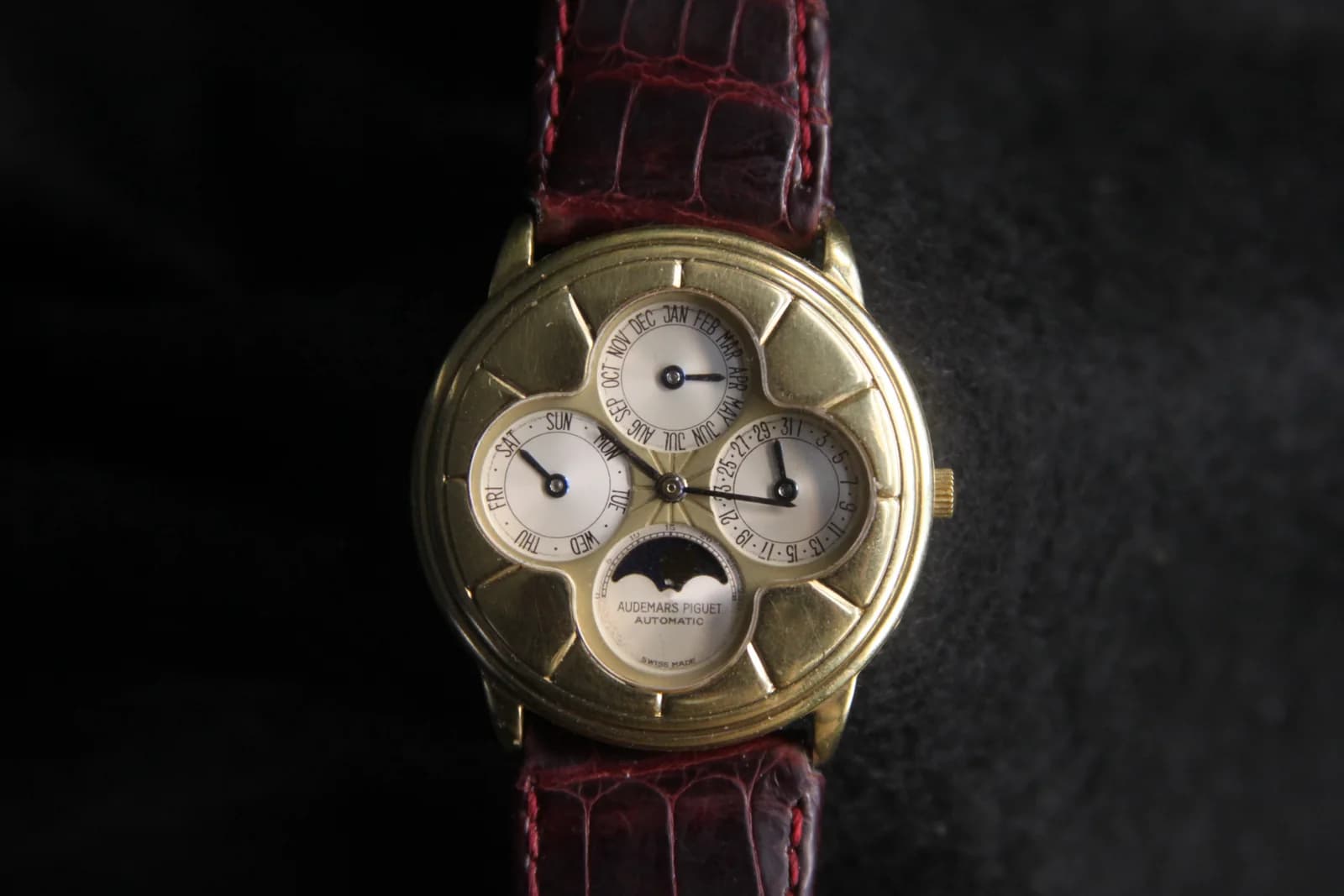
The 5548, 25657 and 25661 belong to the small, round Audemars Piguet perpetual-calendar family often called the AP QP. Their resemblance makes them easy to browse together. It also makes a front photograph a poor place to finish an identification.
The 5548 introduced calibre 2120/2800 in 1978, in a case designed by Jacqueline Dimier. AP later renamed it 25548 as part of its move to five-digit references. A seller using either number may be describing the same model family. AP’s calibre record, AP’s calendar history.
For the 25657, Phillips describes a solid snap-on back and recessed subsidiary dials. Sotheby’s identifies the sapphire display back as the defining feature of the 25661. Its catalogue dates that reference to 1985–1994. These are useful starting points; the photographs and records of the watch being offered still need to agree. Phillips, reference 25657, Sotheby’s, reference 25661BA.
| Reference | Diameter | Caseback evidence | Start here |
|---|---|---|---|
| 5548 / 25548 | 36 mm | Solid; snap-on examples documented | Reference and date in the records |
| 25657 | 36 mm | Solid snap-on | Dial, case and movement together |
| 25661 | 36 mm | Sapphire display back | Back, rotor and supporting documents |
Based on the Christie’s, Phillips and Sotheby’s examples linked in the guide. Nominal diameters; an individual watch still needs examination.
What fits inside 3.95 mm
The shared attraction is calibre 2120/2800: a self-winding perpetual calendar measuring 28 mm across and normally 3.95 mm thick. AP lists 38 jewels, 19,800 vibrations per hour and approximately 40 hours of power reserve. The record also notes some 4.00 mm executions. AP’s technical record.
The 2120 base is 2.45 mm high; the calendar work adds 1.50 mm. These are movement dimensions, so 3.95 mm should never be quoted as the complete watch’s thickness. AP’s calendar history.
The base has a full central rotor with a 21-carat gold weight, supported by ruby rollers on a circular track. It is not a micro-rotor movement. The underlying architecture came from the LeCoultre 920 project, developed with Audemars Piguet and Vacheron Constantin. AP’s calibre 2120 record.
That shared origin gives you a better question to ask than whether a listing calls the movement “in-house”: what is fitted to this watch, and what work has it received? Ask for a sharp movement photograph taken by the seller’s watchmaker, plus the latest itemised service invoice. A photograph through a 25661’s display back is useful, though reflections can hide as much as they reveal.

A perpetual calendar with no leap-year display
The absence of a leap-year indication on these dials can look like a missing feature. AP says it deliberately omitted the indication in the 1978 design to keep the mechanism thin. The calendar still accounts for the four-year cycle; it does not show you its position within that cycle. AP’s calendar history.
That makes a photograph of the correct date incomplete evidence of correct setting. Imagine two watches both showing 1 March. Their visible displays could agree while their calendar mechanisms occupy different years in the cycle. A seller needs to establish the calendar’s setting and operation, ideally through a watchmaker familiar with the calibre.
Ask for a demonstration and a written description of what was checked. A video of a hand moving around the date register alone does not establish that the calendar recognises the end of February. Avoid experimenting with the correctors to find out: get the instructions appropriate to the watch and have its starting position established first.
Reference, case number and movement number are different things
AP’s numbering history separates the reference from the individual case and movement numbers. The reference is only rarely engraved on the watch itself. Case and movement serials identify the individual components; their relationship is recorded in the archives. Neither serial gives an exact production date on its own. AP’s guide to watch numbering.
AP dates the five-digit system to production in 1984–85 and catalogues from 1986. Its case-number ranges overlap: B extends approximately from 1975 to 1990, C from 1984 to 1995, and D from 1991 to 2000. A C prefix is a period clue, not a certificate that a watch was made in a particular year. The material suffix helps separately: BA denotes yellow gold, BC white gold, OR pink gold and PT platinum. AP’s numbering tables.
There is a concrete example of why dates deserve careful wording. Christie’s recorded a 5548, case B25371, as manufactured in 1978 and sold to Germany on 26 January 1979, citing AP’s archives. Both years belong to that watch’s history. A listing should say which event its date describes. Christie’s, lot 5309276.
When comparing listings, keep separate entries for the reference, case number, movement number, stated manufacture date and documented sale date. Leave unknown fields blank. You can then see which dates have documentary support and which are estimates.
How to read the dial and case evidence
Collector guides often separate the 5548 and 25657 by the apparent depth of their subdials. Watch Brothers London discusses that distinction in its reference survey. Yet AP’s archived 1978 drawing specifies a 0.1 mm recess in the 5548 dial plate at the counters. “Flat” can describe how a dial looks in a photograph without being a literal measurement of its construction. Watch Brothers London’s reference survey, AP’s dial drawing.
The same care applies to a caseback. Christie’s describes both its documented 1978 and 1982 examples of the 5548 as having snap-on backs. A solid snap-on back by itself therefore cannot distinguish a 25657 from a 5548. Christie’s, 1978 example, Christie’s, 1982 example.
For a useful dial assessment, request one photograph straight on and another at a shallow angle in diffuse light. Look at the printing, register edges, hands and the surface around the calendar apertures. Ask what is known about replacement or restoration, rather than expecting one “Swiss” inscription or a particular shade of blue to settle the question.
For the case, ask for both flanks, the backs of the lugs, hallmarks and the complete back. Evenly lit photographs make those areas easier to compare than a dramatic wrist shot. If the seller describes the watch as unpolished, ask what supports that description. A clean-looking case is not enough evidence on its own.
Read the label on a production number
A production figure needs a subject and a date range. AP records 6,508 standard 2120/2800 and approximately 791 openworked 2120/2800SQ examples for 1978–1996, grouped by watch sale year. Those figures cover multiple watch models; they cannot stand in for the 5548’s production total. AP’s calibre production record.
For a reference-specific figure, Phillips reports 1,821 examples of the 25657, attributing the number to AP. Sotheby’s reports 244 yellow-gold examples of the 25661. The latter counts one metal, not every 25661. Phillips, Sotheby’s.
Before repeating “one of X made”, ask whether X counts a calibre, a reference, a metal or an exact dial configuration. Then ask where the number came from. None of those totals tells you how many matching watches survive in a particular condition, or how many have changed dials.
Rarity also does little to explain an individual asking price without comparable condition and documentation. Record completed sale dates, currencies and whether a published result includes fees. Keep auction estimates separate from results. When comparing prices, account for the condition, documents and work each watch needs.
An archive extract does not authenticate the watch
AP makes the distinction explicit. An Extract from the Archives certifies that the case and movement numbers appear in its records. A Certificate of Authenticity follows examination of the watch at the manufacture and includes information and photographs of it. The extract itself does not authenticate the watch. AP’s authentication FAQ.
Ask to see the document, including its date and numbers. “With papers” might mean an original guarantee, an archive extract, an operating booklet or a later service invoice. Those documents answer different questions. A box and booklet cannot establish the history of the case or dial beside them.
The service invoice deserves its own reading. Check the date, the watch identification, who did the work and which components were replaced. Ask whether the calendar was included in the work and whether any intervention changed the dial, hands, crown or case finish. A recent invoice is most useful when its scope is clear.
For an example you intend to wear, get a current assessment of function and condition before settling the purchase. Ask the inspecting watchmaker to identify any work needed, explain the correct setting procedure and provide the applicable operating instructions. Keep that record with the watch.
The photographs and answers to request
You can send the following request to a seller without knowing the reference family by heart. It gives you a consistent basis for comparing the responses.
- Identification. Please confirm the full reference, case number and movement number, with photographs where accessible. What document supports the stated year?
- Dial. Please send a straight-on photograph and an oblique view in diffuse light. Is any dial or hand replacement, refinishing or restoration known?
- Case. Please show both sides, all four lugs, the hallmarks and the complete caseback. What is known about polishing or other case work?
- Movement. Is there a clear recent photograph from a watchmaker? Please do not open the case solely for a photograph without the appropriate expertise.
- Calendar. When was the calendar last checked, by whom, and what was tested? Is its position in the four-year cycle established?
- Service and accessories. Please share the latest itemised invoice and photographs of each accompanying document, buckle, box and setting tool.
Once those answers are in, compare the watch with documented examples of the same reference and configuration. Investigate discrepancies individually. An unusual detail may be legitimate, but the explanation should have more behind it than another sale listing repeating the same claim.
If you are choosing between two pieces, send both sets of photographs and documents with your enquiry. The reference comparison above will narrow the questions; the evidence attached to each watch will decide how far you can answer them.
Sources & research notes
Research checked on 6 September 2026. This guide compares published manufacturer records and auction descriptions; it does not report a physical examination of the watches illustrated or cited. The inspection questions and comparisons are Nrbiao’s editorial analysis.
- AP Chronicles · Calibres 2120/2800 and 2120/2800SQ
Technical specifications, first application and movement-family totals.
- AP Chronicles · Royal Oak calendar watches, 1983–1996
5548 renumbering, calendar construction and the archived dial drawing.
- AP Chronicles · Calibre 2120
Base movement, rotor support and development background.
- AP Chronicles · Watch numbering
References, serial ranges, material codes and the limits of dating by number.
- Audemars Piguet · Authentication FAQ
The scope of archive extracts and certificates of authenticity.
- Christie’s · Reference 5548, manufactured in 1978
A documented example: case B25371, sale date and case construction.
- Christie’s · Reference 5548, manufactured in 1982
A second catalogue description of a 36 mm 5548 with a snap-on back.
- Phillips · Reference 25657, Spring 2025
Case and dial description; reference-specific production figure attributed to AP.
- Sotheby’s · Reference 25661BA, March 2024
36 mm case, display back, reference dates and yellow-gold production figure.
- Watch Brothers London · Reference Talk
Further reading: Ben Dunn’s broad reference survey, which prompted this narrower comparison.
Have a document that adds to this guide? Send a correction or source.